We know it's August and it feels early to talk about winter. But paint protection film isn't a same-day service, and the drivers who end up happiest with their winter protection are the ones who plan for it in summer rather than trying to squeeze in an install after the first November salt treatment. Here's an honest look at what winter does to unprotected paint in Maryland, how PPF specifically defends against it, and why the timing math actually favors booking now.
The Real Cost of an Untreated Winter
If you commute on I-695, I-95, US-1, or the Baltimore Beltway during a Maryland winter, your paint takes a beating. Not from a single dramatic event, but from thousands of small ones that add up over months. By spring, unprotected paint often shows visible signs of the season: rock chips concentrated along the leading edge of the hood and bumper, corrosion streaks along the rocker panels, dulling of the clear coat's shine, and stubborn stains around the wheel wells.
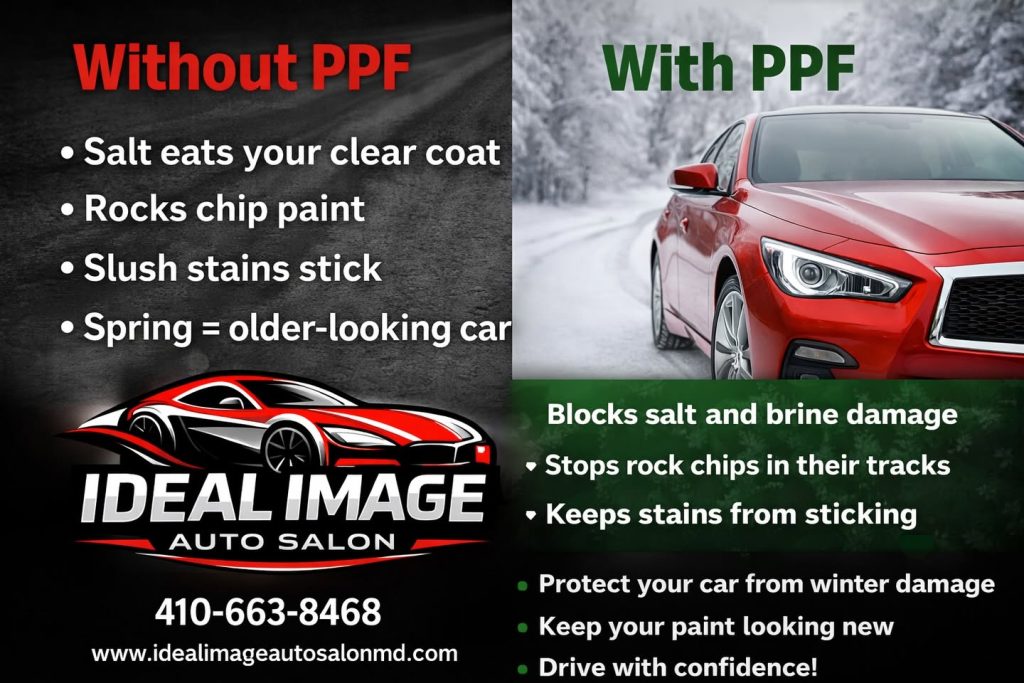
Maryland roads receive salt and brine treatment during winter.
Quality PPF can reduce rock chip damage against unprotected paint.
November through March, Maryland roads routinely see chemical treatment.
The problem isn't that any single storm is catastrophic. It's that Maryland's salt season runs roughly five months, and the daily exposure compounds. A vehicle that looked new in October can visibly show wear by April if it's parked outside and driven daily through the season.
Winter damage is cumulative, not catastrophic. That's why prevention beats repair every time. The steady, invisible daily exposure is what ages paint prematurely.
What Winter Actually Does to Unprotected Paint
Six specific mechanisms attack your vehicle's finish during Maryland winters. Understanding what's happening helps clarify why simple wax or sealant isn't enough for this level of exposure.
Salt Corrosion
Road salt is chemically corrosive. It sticks to horizontal surfaces and reacts with moisture to slowly eat through clear coat. On any existing paint defects, salt accelerates rust formation dramatically.
Brine Chemistry
Maryland uses pre-storm brine treatments that spray liquid salt solution on roads. Brine coats vehicles more thoroughly than dry salt and reaches surfaces that solid salt wouldn't touch.
Rock Chip Impacts
Sand, gravel, and cinders used for traction get kicked up constantly by other vehicles. Each impact chips paint on the hood, bumper, and leading edges. Winter driving multiplies these impacts by 3x to 5x versus summer.
Freeze-Thaw Cycles
Moisture trapped in tiny paint defects expands as it freezes, then contracts as it thaws. This cycle turns small chips into larger cracks and eventually causes peeling or delamination on aging paint.
Ice Scraping Damage
Scraping ice from windshields and windows with the wrong tools frequently marks the paint edge along hood, roof, and door frames. These micro-scratches compound with each storm.
De-Icing Chemical Exposure
Beyond salt, modern road treatments include magnesium chloride, calcium chloride, and other de-icing chemicals. These are aggressive on clear coat and adhere strongly to paint surfaces.
How Paint Protection Film Specifically Defends Against Winter
Paint protection film is a thick, clear polyurethane layer that sits between your paint and the outside world. Originally developed for military aircraft to protect against helicopter rotor debris, PPF is now the standard for serious paint protection. Here's what it specifically does against winter threats.
1 Physical Impact Absorption
The film's thickness (typically 6 to 8 mils, several times thicker than clear coat) absorbs impact energy from rock chips, gravel, and debris before it can damage the paint. Quality PPF can reduce rock chip damage by up to 99% against unprotected paint, and the impacts that would leave chips instead leave marks on the film itself, which can be replaced without affecting the paint.
2 Chemical Barrier Against Salt
PPF is non-porous, meaning salt, brine, and de-icing chemicals cannot penetrate through the film to reach your paint. Even if salt residue sits on the vehicle for days, the paint underneath stays completely isolated from the chemical exposure. This is the single most important winter benefit for Maryland drivers.
3 Self-Healing Properties
Modern PPF is engineered with self-healing top coats that let minor surface scratches disappear when exposed to warmth. Fine marks from winter debris, brush passes, or careless washing gradually fade when the film sits in sun or is exposed to warm water. This keeps the finish looking clean throughout the season.
4 Freeze-Thaw Protection
Because PPF prevents chips from occurring in the first place, there are no defects for moisture to invade during freeze-thaw cycles. This breaks the cascade that turns small winter damage into major paint failure over multiple seasons.
5 Easier Winter Washing
PPF's hydrophobic surface means salt residue, slush, and road grime rinse off more easily than on bare paint. This matters because frequent winter washing is essential to remove salt buildup, and PPF makes that washing significantly faster with less risk of marring the finish.
6 Multi-Year Coverage
Unlike wax or sealant that needs frequent reapplication, quality PPF provides continuous protection for 7 to 10+ years with proper care. A single install carries you through multiple Maryland winters without ongoing maintenance costs.
Paint damage doesn't announce itself. You don't notice the erosion until spring, when suddenly the hood looks tired and the bumper is peppered with chips. By then, correction alone may not be enough to fully restore the finish, which means paying for touch-up or repaint. PPF prevents the problem from starting.
The Four Highest-Priority Protection Zones
Not every panel needs the same level of protection. For Maryland winter driving specifically, these are the zones where PPF delivers the highest return per dollar spent.
Front Bumper and Hood
Highest PriorityThe single most exposed area on any vehicle. Direct impact from every rock chip, salt crystal, and piece of gravel kicked up by traffic ahead of you. On I-695 or I-95, this is where the vast majority of winter paint damage concentrates. Protecting these two panels alone eliminates most winter chip risk.
Rocker Panels
Highest PriorityThe lower side panels below the doors take constant hits from your own tires kicking up debris. In winter, this includes salt, sand, gravel, and slush thrown up at high speed. Rocker panel damage often shows up as chip clusters, corrosion streaks, and eventually rust bubbling if left untreated across multiple seasons.
Front Fenders and Mirrors
High PriorityThe fender leading edges and mirror faces catch the same rock chip and salt spray as the hood, particularly on the passenger side where you get debris from passing vehicles. Mirrors are also vulnerable to brush contact and parking lot damage regardless of season.
Door Edges and Cups
Medium PriorityDoor edges get chipped every time the door opens against a parking lot barrier, and door cup handles show wear from fingernails and rings. These aren't strictly winter concerns but PPF here eliminates common daily damage while you have the vehicle in the shop.
Coverage Options for Maryland Drivers
PPF coverage scales from targeted partial coverage to full body wraps. Here's how the three most common Maryland packages break down.
Partial Front Package
Entry LevelFront bumper plus partial hood coverage (typically the front 18 to 24 inches of the hood). Covers the highest-impact zone for the most concentrated damage without wrapping the entire panel. A common starting point for drivers who want targeted protection at a reasonable price.
Full Front-End Package
StandardFull hood, full front bumper, full front fenders, mirror caps, and headlights. Comprehensive front-end protection with no visible film edges on painted panels. This is the most popular package for Maryland highway commuters and delivers the best balance of coverage and cost.
Track Package Plus Rockers
ComprehensiveFull front-end package plus rocker panels, A-pillars, and often the leading edges of the roof. This is the level we typically recommend for drivers who want comprehensive Maryland winter protection, and it addresses every zone that consistently sees winter damage.
Full Body Coverage
PremiumEvery painted panel wrapped in PPF. Highest cost, most time-intensive install, and complete protection from any impact or chemical exposure anywhere on the vehicle. Common on luxury vehicles, exotics, and high-value EVs where the paint replacement cost justifies the full investment.
For most Maryland daily drivers, the Full Front-End package handles the vast majority of winter risk. Add rocker panels if you commute significant highway miles. For a broader look at how PPF compares to ceramic coating, our guide on ceramic coating vs. PPF covers when each makes sense and when combining them delivers more than either alone.
Why the Timing Math Actually Favors August
Here's the honest calendar reality for anyone considering PPF ahead of winter. Understanding the installation timeline explains why booking in August or early September gets you the best outcome.
The Realistic PPF Booking Calendar
A typical PPF install requires 1 to 5 days depending on coverage, but the film also needs 1 to 2 weeks of gentle care after installation to fully cure and bond. That means an install started in mid-November may still be curing when the first significant salt storm hits. August and September give you comfortable margin for both.
The Combined PPF and Ceramic Coating Approach
For maximum winter protection, PPF and ceramic coating work best together rather than as either-or choices. Here's why this combination has become the standard for owners serious about winter paint preservation.
PPF handles the impact and chemical barrier: rock chips, salt penetration, chemical resistance in the highest-risk zones. Ceramic coating handles the hydrophobic performance, UV protection, and easier washing across the entire vehicle, including on top of the PPF itself. Together, they address every winter threat that Maryland driving throws at a vehicle.
The layered approach also makes both products perform better. Ceramic over PPF makes the film easier to clean and maintain. PPF under ceramic protects the paint from impacts the coating alone cannot handle. Neither is redundant. Each addresses what the other doesn't. For more on how ceramic coating specifically supports winter driving, our guide on ceramic coating for winter protection covers the coating side in detail.
PPF locks in whatever is on the paint at the time of application, for the multi-year life of the film. If your paint has swirl marks, light scratches, or defects, those get preserved under the film. Most PPF installs benefit from paint correction beforehand to ensure the film protects paint in its best possible condition. Our guide on paint correction explained covers when this matters and what to expect.
Maryland Winter Driving: What You're Actually Up Against
A few realities specific to Baltimore County and Harford County driving shape how PPF pays back over a Maryland winter.
Aggressive brine treatments. Maryland DOT applies salt brine to major highways before storms, meaning your vehicle contacts liquid salt solution even on the way to a storm you're trying to avoid. This adheres to lower panels far more thoroughly than dry salt, and PPF is the only protection that fully prevents contact.
Highway commuting exposure. Daily drives on I-695, I-95, US-1, or I-83 mean sustained high-speed contact with debris and salt spray. The higher the speed, the more forceful the impact when a rock or salt crystal hits. Highway commuters see 3x to 5x the chip damage of local-only drivers.
Freeze-thaw variability. Baltimore winters aren't consistently cold. The frequent freeze-thaw pattern is actually more damaging to paint than sustained cold because it repeatedly expands and contracts any trapped moisture in tiny defects. Vehicles from consistent-cold climates often show less paint damage than Maryland vehicles of the same age.
Tesla and EV concerns. Maryland's growing EV population faces additional risk because Tesla and many EVs use thinner, softer paint that shows winter damage faster. For these vehicles, PPF isn't just a nice-to-have. It's often the difference between paint that lasts the ownership window and paint that visibly ages within a couple of seasons. Our guide on ceramic coating for Teslas and EVs covers the EV-specific paint reality.
Book Your Winter Protection Before the Calendar Fills
Bring your vehicle by our shop in Nottingham and we'll walk you through PPF coverage options, show you real film samples, discuss whether paint correction is needed first, and give you a clear quote with a realistic timeline. Booking in August or September means guaranteed availability and full cure time before the first Maryland salt treatment.
Call 410-663-8468Serving Baltimore County and Harford County
Frequently Asked Questions
PPF installation isn't a same-day service, and shops fill up quickly in September and October as drivers realize winter is approaching. A proper PPF install includes paint inspection, thorough decontamination, potential paint correction, careful film application, and multi-day curing time.
Booking in August means you can schedule at your preferred date, have plenty of time for correction if needed, and let the film fully cure well before Maryland's first salt treatment of the season. Waiting until November often means limited availability, weather complications, and less time for coating to properly bond.
Yes, significantly. Road salt is chemically corrosive and reacts with moisture to accelerate rust formation and clear coat degradation. Salt residue clings to horizontal panels, rocker panels, wheel wells, and lower doors, where it slowly eats through paint's protective layers.
The problem is worse in freeze-thaw climates like Maryland where salt-laden moisture repeatedly expands and contracts in tiny paint defects, turning small chips into larger cracks over time. Untreated exposure across multiple winters visibly ages a vehicle's finish.
Paint protection film is a thick, non-porous polyurethane layer that sits between your paint and the outside world. It physically absorbs impact from rock chips and gravel that would otherwise damage the clear coat, and its non-porous surface prevents road salt, brine, and de-icing chemicals from ever reaching the paint.
Quality PPF can reduce rock chip damage by up to 99% and includes self-healing properties that let minor surface scratches disappear when exposed to warm sun. It's the most comprehensive winter protection you can install on a vehicle.
The highest-impact zones for winter damage are the front bumper, hood, front fenders, side mirrors, and rocker panels. The front end catches rock chips and salt spray from other vehicles' tires. Rocker panels get pelted with debris kicked up by your own tires, which is especially problematic in winter when roads are covered in salt, sand, and gravel.
Side mirrors take impacts from passing debris. For Maryland drivers who commute on I-695, I-95, or US-1 in winter, protecting these areas at minimum makes the biggest difference.
They protect against different things and work best together. PPF provides physical impact protection from rock chips, salt crystals, and road debris, and creates a barrier that prevents salt from touching paint. Ceramic coating provides hydrophobic properties, UV protection, and chemical resistance across the entire vehicle, making winter washing significantly easier.
For maximum winter protection, PPF on high-impact areas (bumper, hood, rockers) plus ceramic coating across the entire vehicle is the standard combination. If choosing one, PPF on impact zones addresses the most critical vulnerability.
A partial front install typically takes one day. A full front-end package takes one to two days. Full body coverage can take three to five days. Beyond the installation itself, the film needs time to fully cure and bond to the paint, which can take up to a week or two depending on temperature and humidity.
This is one of the reasons booking early matters. During cure, the vehicle should avoid washing, temperature extremes, and heavy driving conditions. Planning ahead means the install is complete and cured well before winter driving begins.
Questions About Your Vehicle's Winter Protection?
Every vehicle and every driver has different priorities. Give us a call or stop by our Nottingham shop, and we'll assess your specific vehicle, discuss the right coverage level for how you actually drive, and give you a clear quote. We serve drivers across Nottingham, White Marsh, Perry Hall, Bel Air, and the surrounding Baltimore County and Harford County areas.
Ideal Image Auto Salon
7901 Belair Road, Nottingham, MD · 410-663-8468
This article is provided for general informational purposes only. PPF performance percentages reflect industry averages and vary by film type, installation quality, and driving conditions. Coverage recommendations depend on specific vehicle, driving habits, and owner priorities. Professional consultation is recommended to determine appropriate coverage.